Pages

Monday, May 13, 2019

My Sister Angela - A "Band Geek" Rescued from TMJ

Angela Hartley: A “Band Geek” Rescued from TMJ

Angela Hartley grew up in a family that placed high value on learning to play musical instruments. Her mother played violin for a couple of years when she was young, and she has played piano for more than 60 years. Her father played trumpet for 20 years, and for four years in high school and college he also played French horn. He has also noodled on a harmonica for several years. Nearly every member of the family has had instrumental music training of some kind.


Angela as a budding 10-year-old classical pianist
By the time Angela was 16 years old, she had dabbled in viola and clarinet, had nine years of classical piano training, and five years of experience on the alto saxophone. Instrumental music had infused itself into her personal identity and she was proud to be a “band geek” … and an excellent geek at that. She was one of the rare students who earned a position in Murray High School’s highly-awarded jazz band as a sophomore.


Ten-year-old Angela (on the left) playing viola
Angela showing a little junior high school saxophone swagger
Angela at the 2004 state
high school jazz festival in
Park City, Utah
But at age 16, her life dramatically changed. Instead of basking in a joyful sweet-16 birthday celebration, she was in tears. She was cursed with temporomandibular joint (TMJ) disorder. Intense pain coursed through her jaw from her ears to her chin. At times her jaw joint would lock making it extremely difficult and painful to eat ... and impossible to play saxophone.


Angela after jaw surgery in 2004
Her TMJ was so bad that it required surgery to reposition disks in her jaw joint and tighten the surrounding muscles. Her recovery included six weeks of painful physical therapy and a liquid diet.

But Angela’s TMJ disorder was not just painful physically. It devastated her emotionally. It permanently ended her blossoming high school saxophone career in jazz band, concert band, and pep band. It forced her to cancel her weekly private saxophone lessons with a local professional musician. It was heartbreaking when she had to sell her treasured instrument. And possibly worst of all, she lost her close associations with her band friends. Emotionally, all of that combined to wield a devastating blow to the teenager’s sense of self-worth and proud identity as a “band geek.”

Angela and her parents prayed earnestly for divine guidance and help to get her though an extremely painful and depressing time.


Rob Wilson, Murray High
School’s instrumental music director
Not long after her TMJ recovery, Angela learned that the jazz band’s pianist was graduating. Angela wondered if she could become her replacement and be part of the band’s percussion section. But, the odds of rejoining the jazz band as a pianist were highly against her because she only had two weeks to prepare for an audition—an audition with Murray High’s outstanding and very exacting instrumental music director, Rob Wilson. Furthermore, she was never trained in jazz piano. There is a huge difference between Debussy and Duke Ellington! Jazz requires a much different approach to piano than her nine years of classical music had taught her.

Her dad felt inspired to contact Dr. Ray Smith in Provo, Utah. Dr. Smith was the faculty director of Brigham Young University’s highly acclaimed jazz band, Synthesis, to see if he could recommend a teacher for Angela. Dr. Smith referred him to one of his former jazz piano students, a recent BYU music graduate named Amy Ward. Amy was working at Daynes Music in neighboring Midvale, Utah.

But when Angela’s dad telephoned Amy, he discovered that her rates for lessons were much higher than they could afford and she wasn’t willing to reduce them. Before allowing the call to end, he silently prayed for guidance, then explained Angela’s challenging situation. Out of sympathy, Amy reluctantly agreed to let them buy half of a lesson—just 30 minutes—to see how well things would go.

Angela’s “half lesson” went astonishingly well! Amy and Angela developed an instant rapport. Together they enjoyed Angela’s discovery of jazz piano so much, they seemed to lose track of time; the lesson ran more than an hour. Angela proved to be an extremely fast learner. Her dad was awestruck by what she could do after just one lesson! So was Amy!


Arturo Sandoval, Cuban-
American jazz great
Amy agreed to continue to work with Angela for the next two weeks at half her normal price. She gave Angela a very challenging audition piece to learn that was composed by the famous Cuban-American jazz great, Arturo Sandoval.

After only two weeks of tutelage from Amy Ward, combined with intense, concentrated practice, Angela sailed through the audition, totally surprising Mr. Wilson! She earned a spot in the jazz band’s percussion section, which included sharing duties on the piano. She transformed from a person out of harmony with herself into someone with confidence and purpose! She was a proud “band geek” once again!

While in the band’s percussion section, Mr. Wilson taught Angela to play a variety of instruments referred to as mallets: xylophone, vibraphone, and marimba. In the process, she expanded her musical talents and joined her school’s outstanding percussion ensemble and orchestra.


Angela’s love for mallets extended into her college years. In her first freshman semester at Brigham Young University-Idaho, she auditioned for the university’s elite percussion ensemble, Rix Stix. That audition may have been the shortest one in BYU-I’s history. Knowing she had trained under Mr. Wilson at Murray High School, and seeing her technique, the university’s music director stopped her after only one minute into her audition and declared her a member of Rix Stix! Her successful audition also generated an unexpected cash award from the school’s Music Department.


Angela (center, above the university’s percussion director)
in BYU-I’s percussion ensemble, Rix Stix

Angela was blessed to be able to turn the terrible stumbling block of TMJ into stepping stones of new opportunities and personal growth. With divine intervention, people and opportunities were placed in Angela’s life that repaired her jaw, expanded her musical talents, and perhaps more importantly, restored her sense of identity and self-worth as a proud “band geek.”

----------


Written by James E. Hartley, Angela's father, May 2019 and reviewed by Angela herself. 

Sunday, April 14, 2019

My Father Jim - “L” Cones and Green Roses


“L” Cones and Green Roses
From the Life of James E. Hartley

“Hey Jim,” his older brother inquired with a knowing smile. “Do you realize that your shirt doesn’t match your pants?”

“Yes, it does.”

“No, it doesn’t.”

“What do you mean? They’re a great match. And, they’re my favorite pants.”

“Oh, yea? What color are your pants?”

“They’re tan.”

“No, they’re not.”

“What do you mean they’re not? What color are they?”

“They’re lime green,” Richard replied in a tone that communicated clearly without additional words, “This is hopeless!”

Jim Hartley never wore his favorite pants again.

He couldn’t tell that his pants were lime green because he is partially colorblind. He has a genetic flaw in the “L” cones in his eyes (cones in the retina that perceive long color wavelengths, such as red). These cones did not develop properly in his eyes leaving him moderately to severely “red-green deficient.” Depending on how light or dark the colors are, or how bright and intense they are, reds, pinks, greens, grays, purples, browns, and tans can all look alike to him.

The irony is that Jim loves art and is good at it. Over the years, he has become proficient in pencil, charcoal, colored pencils, pen and ink, design markers, pastels (chalk), watercolors, and oil paints.


To adapt to his disability, Jim has worked hard to learn the academics of color: what color an object should be (even if he can’t properly see the color himself), and to learn how to combine colors to achieve the right effect for normal eyes. Then, as long as the pencils, pens, chalk, or paints have labels indicating their colors, Jim can generally figure out how to mix and apply those colors despite his handicap (or he quietly consults with someone with normal color vision).

Anyone looking at his artwork would not guess that he is partially colorblind. His beautiful landscapes in pastels, watercolor, and oil paint decorate the walls of his home.


On birthdays, Jim’s family looked forward to one of his custom-illustrated, full-color banners with their favorite characters.


Similarly, for many years, Jim created delightful cartoon birthday cards for the children of families he was assigned to visit as a home teacher for his church.


He has also illustrated some eye-grabbing holiday displays for his home.


Jim’s first hint that he is colorblind was when he was five years old. In kindergarten, his teacher offered him colored construction paper for an art project. But to get the paper, he had to tell her was color it was. After picking out a sheet, he panicked realizing he had no idea what color it was. A kid behind him came to his rescue by whispering “pink.” To Jim, it could have been light gray, lavender, light green, or tan.

One day when Jim was in first grade, he was walking home from school and noticed a rose bush where the leaves and the flowers were the same color. He made a close inspection. He knew that leaves are supposed to be green, but he had never heard of green flowers before. When he got home, he asked his mom if roses were green. “Of course not,” Mom replied. Then she hesitated and mumbled, “Oh, dear!” His older brother, Bryan, was also colorblind in the same way, so Jim’s mother taught him about his impairment and reassured him that, with help, he could work around it.

His love for art may have started as a toddler when his brother, Richard, introduced him to the fun of redecorating the walls of his parents’ bedroom with crayons. By second grade, Jim had progressed well beyond scribbling on walls. He noticed that a classmate could draw a popular cartoon character, Fred Flintstone, free-hand and without looking at anything. Jim thought if his classmate could do it, he would learn to do it too. And he did. That was the start of an enduring love for cartooning.


When Jim was 10, he and his brother, Richard, joined a weekly art class for kids ages 10 to 15. It was taught by a family friend who was a semi-professional artist. Both boys continued in those lessons for about two years. They learned to work with pencil, charcoal, pastels, and oil paints. (If the teacher ever suspected that Jim was colorblind, she never mentioned it to anyone.) Those art lessons sparked in Jim and Richard a life-long love of art.

At age 14, Jim showed such promising art talent that his parents took out a loan to enroll him in an art correspondence course offered by the Famous Artists School for Young People. Famed illustrator, Norman Rockwell, was one of the founders of the school. For about two years, Jim progressed through the coursework, mailing assignments to the school in Westport, Connecticut where various professional artists graded, critiqued, and returned his art to him. They often complimented him on his use of color.


He also pursued his art in junior high school and high school. He drew sports cartoons for the student newspaper, illustrated covers for the printed programs for school concerts, and did artwork for the school’s yearbook.

Jim’s secret wish after high school was to become a Disney artist. He chose to attend Brigham Young University, but was extremely disappointed to learn that the school didn't teach illustration or animation at the time. Frustrated that he wasn’t learning the kind of art he wanted, he left the art program in his junior year and instead graduated with a bachelor's degree in German studies and a minor in graphic design.

Despite being disillusioned with the university’s art program, Jim found a way to use his art skills to pay for his last three years in college. They also provided a way for him to fulfill an important agreement he had made with his father.

At age 19, after his college freshman year, Jim wanted to serve as a full-time missionary for two years for The Church of Jesus Christ of Latter-day Saints. But he didn’t have the money to pay for it. So, he negotiated an arrangement with his father: Dad would pay for his mission, if Jim would pay for the final three years of his college education.

In 1973, after Jim completed his missionary service, he returned to BYU. Shortly after the semester began, Jim spotted an employment want ad in the school’s student newspaper, The Daily Universe. The newspaper was looking for an art director for its advertising department. He applied and was interviewed on a Friday. The retiring art director, a graduating student, wanted to see a portfolio of Jim’s artwork, which Jim didn’t have. But rather than admit it, Jim simply said he didn’t have the portfolio with him. If he could come back, he would bring it the following Monday. Another appointment was made.

Jim hurried to his apartment to study back-issues of The Daily Universe to see what kind of artwork they needed. He went to the university bookstore and bought a portfolio case, drawing paper, and a variety of pens. He then drew furiously over the weekend. On Monday, he handed in his portfolio, the ink on his drawings barely dry. The art director was impressed, immediately showed Jim’s work to the faculty advisor, and Jim was hired on the spot.

Jim at BYU during the 1970s

It turned out to be one of the higher paying part-time jobs on campus and Jim was ecstatic! He was the art director for three years, and it almost paid for all of his final three years of college. To augment his income, Jim did freelance illustration for one of the BYU chemistry professors and for local merchants. He even won a logo design contest, with a cash award, for BYU Women’s Intramural Sports. Jim felt extremely blessed, his art ability made it possible to pay for nearly all of his college, and, just as important, to keep his agreement with his dad.

Jim’s college art experience was also the start of many years of freelance illustration and design work, which paid a lot of family bills as the years went by.

He has experienced many embarrassing moments because of his colorblindness, such as when buying clothing (“Jim, that tie is lavender, not gray.”), cooking and barbequing (“Someone please tell me if the meat’s cooked yet!”), looking at scenery (“Really, the trees on the mountainside have turned red?”), or decorating his home or office (“What? That’s brown not green?”). He was in a subway once where the various train lines were color coded. He knew he needed to take the red line, but could not tell which one it was from the colors on the sign. Weather maps on the TV news also confuse him. It is not uncommon for him to lament quietly to his wife, “I wish I could see colors the way you see them. Hopefully, in the next life ….”

Because of his color deficiency, he frequently depends on help from others and even from heaven. Jim has recorded in his private journal several times that important art projects were rescued by divine intervention. There were times when a power beyond his own enlightened his mind and even moved his hands.

There are two profound verses in the Book of Mormon that have deep personal meaning for Jim:

… I give unto men weakness that they may be humble; … if they humble themselves before me, and have faith in me, then will I make weak things become strong unto them. (Ether 12:27-28)

Jim has been given a talent for art, yet is handicapped by his partial colorblindness. But, thanks to the grace of God, that handicap has never gotten in the way of his ability to develop and use that talent to provide for his family, and to love and serve his family and others through his art. Truly, for Jim and his art talent, God has made weak things become strong.

Jim Hartley, November 2014

April 2019. Originally written by son, Tom Hartley, and revised and edited by Jim Hartley. Reviewed by Jim's brother, Richard Hartley.

Images are original artwork by Jim Hartley himself.

Sunday, February 10, 2019

My Brother Taylor - Courage in Chaos


I want to share and preserve an email my brother, Taylor Hartley, wrote to the family in late September 2000. He was a student at the BYU Jerusalem Center in Israel, and he found himself in the middle of violent riots that broke out at that time. His life, and that of his friends, was in great danger. I appreciate the courage Taylor exhibited and the care he showed to his friends during very tumultuous circumstances. Below are Taylor's own words:

Dear Family,

Today in our first class [at the BYU Jerusalem Center], one of our head administrators came in and told us that because of some recent outbreaks in and around the city, we could only leave the center from noon and until 2 p.m. and only go to change our money for our trip to Jordan coming up. The money changer's place wasn't in the old city that was off-limits, but our way to it lead past it. At about 1:00, I left with two friends and went to the money changers. It was pleasant outside and everything was normal. I changed my money, as well as two other friends' checks they gave me, to exchange.

Taylor on the left in a white shirt
At the Holy Mount

When we left the building, we were met immediately by two Israeli men who told us to hurry back and tell all our other friends to go home as fast as we can. Other residents similarly told other students. We didn't think much of it, but kept walking. Then we went and looked across the street to Damascus gate -- masses of people were rushing out of the old city or Temple Mount and running. Some group was carrying a body -- dead or alive we couldn't tell. Hordes of people were all over the streets and ambulance after ambulance came screaming past us. Traffic was dense and going fast. Horns were sounding like nuts. I was worried for us, so I made sure to hurry them along and watched out for any aggressive moves on us. All around us was panic. It was so sudden. The atmosphere had changed. We were in a war zone, and I felt it. I was determined to help all of us home. Crowds of people along the tight roads were in front of us as we struggled frantically to get home.

Damascus Gate

We finally got to a crosswalk. Palestinian people were everywhere in the roads. Cars were flying past us at insane speeds and driving out of control. Sirens and flashing lights were everywhere. Some of us witnessed traumatic scenes of medical injuries involving a lot of blood as injured people hung out of ambulances and cars filled with people. In other places, the traffic was so jammed up people were attacking cars and shattering windows. Violence was all around and people hurting people was witnessed. One of my friends began to get extremely traumatized by all of it. I told her not to look around but concentrate on getting home and just look straight in front of her. Occasionally she looked about in horror and shuttered at the bloody and violent scenes.

We continued to run down the streets dodging people and staying free of the cars and emergency vehicles speeding by us very closely. It was mass confusion and hysteria. Families and people on the street sides stood in tears and others watched as the crowds of rioting were happening.

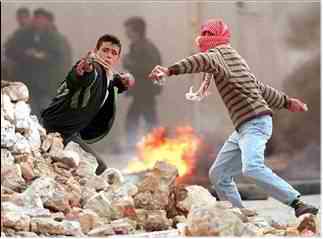
A riot scene

We kept moving hastily and began ascending back towards the [BYU Jerusalem Center]. Things [now] seemed to be a little less congested, but the traffic was absolutely lethal. Ambulance after ambulance screaming, car after car zooming on the wrong side of the road, passing other cars in front of them. It all kept going on and on. Crossing the street was putting our lives in danger.

All of us successfully crossed the street, eventually, as I helped direct them to run at the right moment. However, I and another waited for our Korean friend to get across after trying to buy milk quickly that she supposedly needed from a little shop. As we waited, the girl with me insisted that she must run across the street and be with our other friend, but I took hold of her, looked her in the eyes and directed her to stay on the side of the road and not go back -- she could get killed and others trying to help her may get killed also. She nearly burst into tears as she realized how crazy and panicked she was in the midst of all this mass hysteria. She thanked me for setting her straight.

We all finally made it back to the Center safely, reported to the student keeping track of all other students and counting who made it, and began to catch our breath. The girl I was with was in tears nearly the whole trek back to the Center, fearing for herself and cringing at the terribly frightening scenes before her. She held onto me nearly the whole way home, and I tried to comfort her as we went, as well as others too. She had witnessed people wounded from gunshots, probably, and other injuries. She had seen people hurting each other and the violence. I, however, didn't see a thing -- not one bloody person or act of violence, and I didn't see the body being carried. That's fortunate, I think. I was so focused on getting the girls back safely that I was watching intently on our immediate surroundings. I did see people crying on the street sides and couldn't help but notice the seemingly thousands of ambulances that screamed past us.

A riot scene

Back at the Center, after talking a lot with other people shook-up, and after explaining to others what had happened, I went on to a balcony with a lot of other students and watched the city. Black smoke billowed in the air from some fire. People were everywhere, traffic was nuts, and the whole city before us seemed to be in commotion. I looked, and directly in front of me, I witnessed in the distance a police car explode into leaping orange flames and black smoke. Cars continued to cruise past the burning, smoldering mass. The bang sounded about a second later.

BYU Jerusalem Center

The experience was intense. We were all gathered into a big auditorium-like room and watched CNN live on a big screen. Apparently what happened at the time we were outside the old city walls, and within the Temple Mount where the Dome of the Rock is, Muslims were getting finished with a prayer service when some Israeli police entered the Muslim turf. They were motivated to do this because of recent political negotiations and to prevent any problems. Also because of the political situation, the police were armed and shielded. The Muslims got mad at the "trespassing" Israeli police and so they began throwing rocks at them. The police hid behind their shields, but then decided to stop the conflict by shooting them with rubber bullets. Arab/Muslim snipers outside the area began shooting the police with real bullets. Because of that, the police also began shooting real bullets. That's when all the injuries began happening. Last I heard, about four were killed and hundreds of people were injured. As this was happening, we were going past the gate where a lot of people were scrambling to leave the Temple Mount where all the violence had started in the first place. Also, the political situation which started this fight began yesterday. It's pretty complicated, but because of it, many more Palestinians (Arabs and/or Muslims) began pouring into the city.

Overhead sonic booms crashed loudly, shaking the Center as (military?) aircraft reached supersonic speeds, breaking the sound barrier. The unexpected, loud noises startled me while studying The Book of Mormon along side some friends. A boom exploded and made me involuntarily throw the scriptures to the floor, turn around, and be ready to fight with my fists raised and being planted in a fighting stance. I also yelled aggressively as I've been trained to. It took a bit to calm my heart and cease hyperventilating. It was pretty funny to friends around me. We all had a good laugh.

So, I'm grateful to be alive right now, and I'm glad everyone else is safe too. It's a miracle we all made it home with the mass confusion and hysteria that permeated every space around us. We were consumed in panic and floods of insanely life-threatening traffic.

We've been told not to go to our balconies and watch the events, or take pictures if there are problems along the road nearest us. The reason why is that “bullets don't know who you are.” We're under orders to stay inside the building for all of today and the rest of tomorrow. Hopefully we'll be able to escape to Jordan on Sunday and when we come back, things will be back to relative harmony again.

That's what's happening back here. I haven't been shook up really. I'm feeling okay. So there's no need to be worried.

Love,
Taylor


Taylor at Qumran Cave 4
Where many of the Dead Sea Scrolls were found


Sources

"Jerusalem Outbreak." An email from Taylor C. Hartley dated Friday, September 29, 2000. Edited slightly for clarity and removed some referenced names for privacy. 


Tuesday, December 11, 2018

My Uncle Bryan Hartley - From Stranger to Beloved Big Brother


December 26, 2004 marks when my uncle, Bryan Hartley, passed away. In light of the soon approaching 14th anniversary of my uncle Bryan's passing, I would like to share this great story my father, Jim Hartley, prepared some time ago. Uncle Bryan was a tremendously positive influence on my father, who in turn, has been a tremendously positive influence on me. Below are my father's own words:


Bryan Paul Hartley:
From Stranger to Beloved Big Brother in 56 Miles

Hal Throolin
The hike was actually Hal Throolin’s idea. Each springtime, soaring mountain peaks and challenging hiking trails called his name. Hal heard their call in early 1965 and persuaded his neighbor and buddy, Richard Hartley, my brother, to join him later that summer for a seven-day adventure in California’s rugged Sierra Nevada Mountains.

For this adventure, Hal had immersed himself in detailed topographical maps from the United States Geological Survey (USGS). He identified the highest mountain passes, the coldest lakes and streams, and the most remote Alpine meadows he could find in Yosemite National Park that were connected by wilderness hiking trails. When he was done, he had charted a complex, circuitous, 56-mile route that twisted, turned, and snaked all over the compass. Three-fourths of the hike would be above an elevation of 9,000 feet—an altitude where the air is so thin that dandelions, mountain lions, and mosquitos can’t breathe. This was a route that would have made Daniel Boone shake his head in disbelief.


Mama Bears

But, Daniel Boone didn’t need to. Merline and Norma, Hal’s mom and Richard’s mom, immediately shook their heads “no!” These “mama bears” simply were not going to allow their 16-year-old “bear cubs” meander alone in some of California’s wildest and most rugged mountain regions.

With determination, Hal and Richard became very persuasive. They made the hike sound downright civilized by emphasizing that most of it would be on the well-marked, popular John Muir Trail, and they would be in Yosemite National Park nearly the entire time. There would be park rangers, and plenty of water, and places to fish, and they would hike where there were no boa constrictors, grizzly bears, or Big Foot.

Eventually, Norma and Merline softened. They deliberated and came up with a non-negotiable counter-plan that would resolve most of their mama-bear concerns. First, Jimmy must tag along. I’m sure their hope was that Richard and Hal wouldn’t do anything too dangerous or dumb if they had to be responsible for me, Richard’s 13-year-old little brother. Second, our 25-year-old brother, Bryan, must also go with us as our guardian, safety warden, and law enforcement officer. With “no hike” as the only other option, Bryan and I were in, and the four of us would explore the high Sierra’s in July 1965 under Bryan’s command.

The Stranger
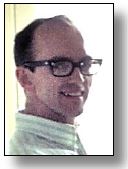
Bryan Hartley
Frankly, adding Bryan was a little surprising to us. Of the five Hartley boys, Bryan was the second oldest, and Richard and I were the two youngest. At that stage in our young lives, the age and maturity gaps between us and Bryan were huge: nine years for Richard and 12 years for me—Bryan was nearly twice my age! And Bryan? He was basically a stranger to us. All we knew for sure was that Bryan had been a Mormon missionary in Germany, had studied physics and engineering at the University of California in Berkeley, and had just earned a bachelor’s degree in German and science from Brigham Young University in Utah.

So, for Richard and me, a big question in our minds was, “How well will we get along with this stranger, who happens to be our older brother?”

The Plan

When the time came, our dad drove us 200 miles due east from our home in San Lorenzo through the entire width of Yosemite National Park to the drop-off point at Dana Meadows. There, on the eastern slopes of the Sierra’s, the four of us would start our wilderness trek at an elevation of 9,700 feet. After working our way more-or-less westward, Dad would pick us up again seven days later at a designated rendezvous spot in Yosemite Valley.

Dana Meadows

Grueling First Day

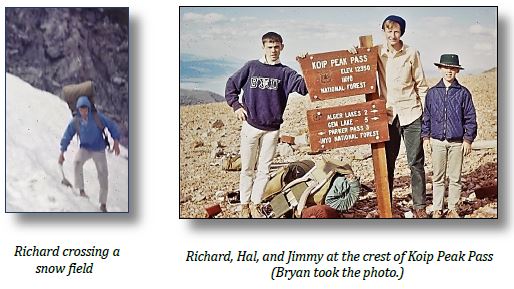
After the four-hour drive from San Lorenzo, the first day of hiking was supposed to be an easy 11 miles from Dana Meadows to Alger Lakes. It turned out to be grueling! First, there was a 1,400-foot climb to Parker Pass at 11,100 feet, followed immediately by an 1,800-foot climb by way of some tight switchbacks up to Koip Peak Pass with its elevation of 12,350 feet. The final stretch was a 1,600-foot descent from Koip Peak Pass down into a small basin containing snow-fed Alger Lakes at 10,700 feet.


As the four sea-level suburbanites ascended higher and higher, the trees shrank in size and number, then disappeared completely, replaced by scrawny bushes and grasses, which were soon replaced entirely by talus—slopes of countless small, jagged, rock fragments that had broken off of the mountains over thousands of years. Breaking the monotony of the talus switchback trails were small snow fields that blanketed the trail in places that saw little, if any, sunshine.

The “Runt” . . . Off to a Difficult Start

Bryan, Richard, and Hal seemed to handle the difficult trail and extreme elevation changes pretty well. But, the “runt” of the foursome, me, didn’t know if he could make it. After crossing Parker Pass, I had to stop. My head ached. I was light-headed and a little dizzy. I was nauseous and weak from head to toe.

That’s when Bryan, the stranger, began to become Bryan, our beloved big brother. He recognized my condition as altitude sickness—too much elevation change too soon. He halted our mountain march so that I could get acclimatized. As I rested, Bryan tended to me and encouraged me. I realized then that he genuinely cared about his youngest brother. While I was acclimatizing, I’m pretty confident Hal and Richard were thinking, “Why did we have to bring Jimmy along? He’s going to ruin the hike.” But, I never actually heard it. Bryan kept things positive, and I was extremely grateful.

After a short time, I began to feel better. We resumed our hike up to Koip Peak Pass. To help me, Bryan compassionately carried my 35-pound backpack and sleeping bag for a while, in addition to his own much-heavier gear. We ascended the narrow talus trail single-file, with Hal in the lead. More than once, Bryan directed Hal to slow down a little—no doubt so that I could keep up.


One of the snow fields covering our upward trail was fairly large. Hal wanted to play on it. Specifically, he wanted to glissade down it, which is to “surf” or slide down on his feet. Bryan looked at the sharp-edged, unforgiving talus at the bottom of the snow field, and with absolute authority in his voice, he stopped Hal from snow-surfing. Guardian, safety warden, and law enforcement—just as Mom had intended.

Lightening and Light

On Sunday, our second day of hiking offered a different challenge. We left Alger Lakes and headed south to Gem Lake. We were approaching the crest of Gem Pass, elevation 10,400 feet, when an angry thunderstorm suddenly rolled in. Not wanting us to be targets
A mountain thunderstorm rolling in
for lightning, Bryan had us double- time up and over the pass and down into lower, safer terrain. We stopped in a somewhat protected area. Bryan instructed us to stretch rope between two scrawny trees and connect three of our tube tents together into a single, heavy-duty plastic tunnel. The four of us quickly built and crawled into the shelter with our gear just before the storm hit us.

That’s when we learned that Bryan was not only kind, compassionate, strict (when needed), and smart, he had a deep love for sacred things.

That second day was Sunday, the Sabbath Day. While we sat close together in the narrow tube tent tunnel, Bryan prepared a brief worship service for us, including the sacrament. He had obtained permission from our bishop at home to bless and pass the bread and water, emblems of the Savior’s body and blood; a remembrance of God’s supreme love for us and of our covenants with Him. While wind, lightning, thunder, and rain prevailed outside, there was peace, love, and calm inside. We needed our flashlights to illuminate the darkness in our tents. But, a sweeter, brighter light—the light of the Holy Spirit—illuminated our souls. We will never forget the physical and spiritual warmth of that short sacrament service. At the same time, our admiration and love for our big brother, Bryan, mushroomed.

A Romantic

During the first few days, we discovered a tender side of Bryan. From time-to-time, he would pick a small stem of wildflowers and carefully press it in a book. We later found out that our “commander” was also a thoughtful and hopelessly smitten romantic—the pressed wildflowers were for a sweet young lass in Utah.

A Fantastic Journey

The rest of the trek to Yosemite Valley continued to be a fantastic journey. We had a brief encounter with an angry, hissing, teeth-bearing badger protecting its trail-side den. But otherwise, we never had any problems with wildlife. If they were there, they kept a secretive, safe distance from us.

Other than that brief Sunday thunderstorm, we were blessed with beautiful, friendly weather the entire way. We even enjoyed our dehydrated food. We had plenty of water from streams, rivers, and lakes, and Hal and Richard actually caught a fish or three. But, the “popular” John Muir Trail wasn’t very popular where we hiked. We were virtually alone in our journey.

Those 50-plus miles of trekking in the Sierra Nevada wilderness qualify for the most superlative application of awesome that man can bestow. Even if you’ve been there, no words can adequately describe the amazing beauty, the exceptional sounds and smells, and the majesty of the mountains, meadows, trees, lakes, and streams of God’s high country. And, the most stunning of all are the heavens at night. No photographer or painter will ever capture the breath-taking feeling that envelopes you under the expansive dome of an exquisitely clear, bejeweled alpine night sky!


Tent City

During the last two days of our hike, we descended some 4,000 feet in elevation into Yosemite Valley and precisely on schedule. But, after the peace and solitude of the previous six days, our entry into the valley was somewhat of a shock. The valley floor was carpeted with hundreds of tents and masses of boisterous campers.

Campers on the floor of Yosemite Valley

An hour or two after we arrived, Bryan somehow filtered through the masses and found Dad, and we were soon on our way home. We were sad our hike was over, but very pleased to leave Yosemite Valley’s sprawling, noisy tent city.

Fifty-six Miles . . . More Than Just a Hike

As difficult as the hike was in places, Hal Throolin’s seven-day adventure in the high Sierra Nevada Mountains was incredible! Our love grew enormously for nature, the night sky, and for their Creator. The hike also brought us a wonderful sense of achievement and self-confidence. One of the best and most unexpected benefits came because of Bryan. In those 56 miles, Bryan became a much-beloved and admired big brother for the rest of our lives.

Bryan Hartley
Bryan went on to blaze an exceptional trail for his younger brothers, inspiring us to excel in education, make and keep divine covenants, advance in the priesthood, serve LDS missions, marry well and raise families, and set high personal and professional goals and standards. Richard and I will be eternally grateful to Bryan for his role during an incredible hike, both in the Sierra Nevada Mountains and throughout our lives.


-------------------------------------------------------
Written by James E. Hartley, Bryan’s brother.
-------------------------------------------------------

Source:

Family Story Gems: Bryan Paul Hartley: From Stranger to Beloved Big Brother in 56 Miles. By James E. Hartley.

Also available at FamilySearch.org:


Photo Acknowledgements

John Muir Trail sign: https://static1.squarespace.com/static/567458129cadb68edf3ff563/t/58403b86893fc05b6ec64454/1480604556938/
Dana Meadows: http://www.itoda.com/photos/yosemite/DanaMeadows-01.jpg
Parker Pass: http://www.meghanmhicks.com/wp-content/uploads/2010/08/DSC05049.jpg
Talus trail: https://lh5.googleusercontent.com/-BNoCDC8Asr4/U9tQ4b-EoFI/AAAAAAAABiM/_GzjG2YC-YQ/s1600/0_IMG_1586.JPG
Wild flowers http://peaksforfreaks.blogspot.com/2013/06/koip-peak-kuna-peak.html
A badger: http://portfolio.jeffwendorff.com/img/s2/v1/p178168139-3.jpg